|
A view to Rock History. |
||||
|
Rock Music. Rock
Music, group of related music styles that have dominated popular music in the
West since about 1955. Rock music began in the United States, but it has influenced
and in turn been shaped by a broad field of cultures and musical traditions,
including gospel music, the blues, country-and-western music, classical music (see
Music, Western), folk music, electronic music, and the popular music of Asia,
Africa, and Latin America (see World-beat). In addition to its use as a broad
designation, the term rock music commonly refers to music styles after 1959
predominantly influenced by white musicians. Other major rock music styles
include rock and roll (also known as rock
'n' roll), the first genre of the music; and rhythm-and-blues music (R&B),
influenced mainly by black American musicians. Each of these major genres encompasses
a variety of sub-styles, such as heavy metal, punk, alternative, and grunge.
While innovations in rock music have often occurred in regional centers-such
as New York City, Kingston, Jamaica, and Liverpool, England-the influence of
rock music is now felt worldwide.
Les Paul Custom Guitar. This solid body electric guitar was made by the Gibson company in collaboration with the musician Les Paul. It was designed to compete with the Fender electric guitar and has been a very popular instrument ever since its beginnings in the mid-1950s.
Musical Elements. The
central musical instrument in most kinds of rock music is the electric guitar.
Important figures in the history of this instrument include jazz musician Charlie
Christian, who in the late 1930s was one of the first to perform the amplified
guitar as a solo instrument; Aaron Thibeaux
"T-Bone" Walker, the first blues musician to record with an amplified
guitar
(1942); Leo Fender, who in 1948 introduced the first mass-produced solid-body
electric guitar; and Les Paul, who popularized the instrument in the early
1950s with a series of technologically innovative recordings. Rock-and-roll
guitarist Chuck Berry established a style of playing in the late 1950s that
remains a great influence on rock music. Beginning in the late 1960s a new
generation of rock guitarists, including Jimi Hendrix, Eric Clapton, and Carlos
Santana, experimented with amplification, feedback (a type of electronic sound
distortion), and various electronic devices, extending the musical potential
of the instrument.
Historical development. The
first type of rock music, rock and roll, originated in the United States in
the 1950s, and was largely derived from music of the American South. In the
United States, the affluence that followed the end of World War II in 1945
and the emergence of a youth culture-based in part upon the rejection of older
styles of popular culture-helped rock and roll to displace the New York City-based
Tin Pan Alley songwriting tradition that had dominated the mainstream of American
popular taste since the late 19th century
(see Popular Music: Early 20th Century). Rock and roll was a combination of
the R&B style known as jump blues, the gospel-influenced vocal-group style
known as doo wop, the piano-blues style known as boogie woogie (or barrelhouse),
and the country-music style known as honky tonk.
The British Invasion. Ιn
1964 the Beatles traveled to New York City to appear on a television broadcast
("The Ed Sullivan Show," 1948 to 1971) and launched the so-called
British Invasion. Influenced by American recordings, British pop bands of the
period invigorated the popular music mainstream and confirmed the international
stature of rock music. Soon, several British groups had developed individual
distinctive styles: The Beatles combined the guitar-based rock and roll of
Chuck Berry and Buddy Holly with the artistry of the Tin Pan Alley style; the
Animals blended blues and R&B influences; and the Rolling Stones joined
aspects of Chicago blues to their intense, forceful music.
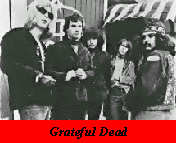
Psychedelic Rock. San Francisco rock, or psychedelic rock, emerged about 1966 and was associated with the use of hallucinogenic drugs, such as Lysergic Acid Diethylamide, or LSD; psychedelic art and light shows; and an emphasis on spontaneity and communitarian values, epitomized in free-form events called be-ins. Musicians such as Jerry Garcia and the Grateful Dead experimented with long, improvised stretches of music called jams. Despite the antiestablishment orientation of the youth culture in San Francisco, such musicians and groups as Jefferson Airplane, Janis Joplin, and Santana (led by Carlos Santana) signed lucrative contracts with major recording companies.
Los Angeles 1960's. Another important center of rock music in the 1960s was Los Angeles, where film student Jim Morrison formed the group the Doors and guitarist and composer Frank Zappa developed a unique blend of risquι humor and complex jazz-influenced compositional forms with his group the Mothers of Invention. In the late 1960s hard rock emerged, focusing on thick layers of sound, loud volume levels, and virtuoso guitar solos. In London, American Jimi Hendrix developed a highly influential electric-guitar style. His fiery technique gained exposure at the first large-scale rock festivals in the United States, Monterey Pop (1967) and Woodstock (1969). In 1966 the first so-called power trio was formed in London-the band Cream, which showcased the virtuosity of guitarist Eric Clapton, bassist Jack Bruce, and drummer Ginger Baker. In the late 1960s additional styles emerged in the United States, including southern rock, pioneered by the Allman Brothers Band; jazz rock, proponents of which included the band Blood, Sweat and Tears; and Latin rock (a blend of Latin American music, jazz and rock influences, and R&B styles), exemplified by the music of Santana.
Woodstock, 1969. The Woodstock Art and Music Fair of 1969 drew more than 300,000 spectators to become one of largest mass-gatherings in the history of popular music. Many arrived up to a week before the outdoor event, drawn by the free-spirited, communal atmosphere as well as the legendary musical acts. The numerous performers included guitarist Jimi Hendrix, soul group Sly and the Family Stone, and rock groups the Grateful Dead and the Who.
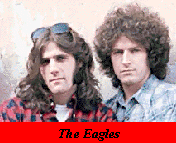
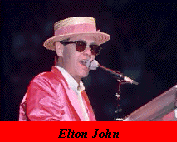
1970's. In
the early 1970s the popular mainstream was dominated by superstar rock
groups, such as the Rolling Stones, the Eagles, Fleetwood Mac, and
Chicago, and by individual superstars, such as Stevie Wonder and Elton
John. Each of these groups and individual artists produced multiple
albums, each of which sold millions of copies, pushing the industry to
operate at a new scale.
Disco & Rock. The most popular dance music of the 1970s was disco. Initially associated with the gay subculture of New York City, disco drew upon black popular music and simplified rhythms by adding steady bass-drum beats. Although much despised by aficionados of heavy metal, disco had a substantial impact on rock music, especially after the release of the motion picture Saturday Night Fever (1977) and its hugely successful disco soundtrack featuring the group the Bee Gees.
Funk & Rock. The 1970s also saw the development of funk, a variant of soul music that was influenced by rock. Influential funk musicians included singer Sly Stone with his San Francisco band Sly and the Family Stone, and vocalist George Clinton, whose groups Parliament and Funkadelic blended social satire and science-fiction imagery with African-derived rhythms, jazz-influenced horn music, long improvised jams, and vocal group harmonies.
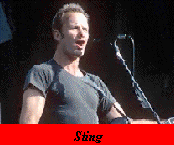
Punk Rock. About 1976 punk rock originated in New York City and London as a reaction against the commercialism of mainstream rock and the pretentiousness of art rock. Punk-rock music was raw, abrasive, and fast. London punk groups included the Sex Pistols, the Clash, and the Police (see Sting), while New York punk and new wave (a style similar to punk) music included the bands the Ramones, Blondie, and Talking Heads, and vocalist Patti Smith.
Reggae. Also in the mid-1970s, reggae music-developed by musicians in the shantytowns of Kingston, Jamaica-began to attract attention among youth in Great Britain and the United States. The style, associated with political protest and the Rastafarian religion, combined elements of Jamaican folk music with American R&B influences. Reggae's popularity among American college students was stimulated by the 1973 film The Harder They Come, which starred reggae singer Jimmy Cliff in the role of an underclass gangster. The superstar of the style was Bob Marley, who by the time of his death in 1981 had become one of the most popular musicians in the world.
Concerts & Radio Programms. Despite these diverse stylistic developments, the music business in the United States had actually become more centralized in the 1970s. Spontaneous mass gatherings, epitomized by Woodstock, had been replaced by carefully managed stadium concerts. The individualistic local radio programming of the late 1960s was substituted with national radio formatting, in which music tailored to sell products to certain audiences was distributed nationally on tape to be broadcast from local stations. Economic factors encouraged major record companies to pursue almost exclusively artists with the potential to sell millions of copies of albums. While potential profits from hit albums had risen greatly, the financial risks involved in producing such music had also increased considerably. From 1978 to 1982 the American rock-music industry experienced financial difficulties as sales of recorded music dropped by almost $1 billion and receipts from live concerts experienced a similar decline.
1980's. Technological advances led to a revival of the music industry during the 1980s. The market for popular music expanded with new media formats, including music video, introduced by the Music Television (MTV) network in 1981, and the digitally-recorded compact disc, introduced in 1983. In 1982 entertainer Michael Jackson released Thriller, which became the biggest-selling album in history, and established a trend in which record companies relied upon a few massive hits to generate profits. Jackson's success contributed greatly to proving the promotional value of music videos. It thereafter became very difficult for record companies to achieve hit records without having the music receive intensive airplay on music-video networks.
Ethnopop. Anticipated by reggae in the 1970s, worldbeat music (also called ethnopop) began to emerge during the early 1980s, with the success of the album Juju Music (1982) by Nigerian musician King Sunny Ade music, which blended traditional African drums with electric guitars and synthesizers, helped to stimulate an interest in non-Western music in the United States and Great Britain, and opened the way for artists such as Youssou N'Dour, from Senegal; Papa Wemba, from the Democratic Republic of the Congo (DRC, formerly Zaire); Ladysmith Black Mambazo, from South Africa; Ofra Haza, from Israel; Nusrat Fateh Ali Khan, from Pakistan; and the Gipsy Kings, from France. Rock superstars, such as Peter Gabriel, David Byrne, and Paul Simon, whose 1985 album Graceland featured musicians from Africa and Latin America, played an important role in exposing worldbeat musicians to audiences in the United States and Europe, and reaffirmed the worldwide appeal of rock music.
Rap. Perhaps
the most significant rock-music development of the 1980s was the rise of
rap, a genre in which vocalists perform rhythmic speech, usually
accompanied by music snippets, or samples, from prerecorded material or
from music created by synthesizers. Rap originated in the mid-1970s in the
South Bronx community of New York City and was initially associated with a
cultural movement called hip-hop, which included acrobatic dancing (known
as break dancing) and graffiti art. DJs such as Kool Herc and Afrika
Bambaataa experimented with innovative turntable techniques, including
switching between multiple discs; back-spinning, or rotating the disc by
hand in order to repeat particular phrases; and scratching, moving the
phonograph needle across vinyl record grooves to create rhythmic sound
effects.
Current trends. Rock
music has grown to include hundreds of musical styles, some of which
define a broad mainstream, while others are supported by small but devoted
audiences. As in earlier decades, major record companies have used
independent labels to find new trends and locate promising talent.
Sociological Significance. Since
its inception in the 1950s, rock music has moved from the margins of
American popular music to become the center of a multi-billion-dollar
global industry. Closely connected with youth culture, rock music and
musicians have helped to establish new fashions, forms of language,
attitudes, and political views. However, rock music is no longer limited
to an audience of teenagers, since many current listeners formed their
musical tastes during the golden age of rock and roll. Similarly, while
rock has historically encouraged new creative expressions, the innovations
of Chuck Berry, Elvis Presley, Bob Dylan, the Beatles, and Jimi Hendrix
have defined a tradition to which successive generations of musicians have
repeatedly turned for inspiration.
Solid-Body Electric Guitar. This solid-body electric guitar is a Stratocaster, made by the Fender company. Unlike acoustic guitars, the electric versions create sound by converting the vibrations from the strings into electronic impulses. The Stratocaster was first made in the mid-1950s and has changed little since that time. It is very popular with rock-and-roll musicians.
Rhytm-and-Blues. Rhythm-and-Blues
Music or R & B, variety of different, but related, types of popular
music produced and supported primarily by black Americans beginning in the
early 1940s (see African American Music). Rhythm-and-blues music, also
known simply as rhythm and blues, embraces such genres as jump blues, club
blues, black rock and roll, doo wop, soul, Motown, funk, disco, and rap.
First coined in 1949 by Jerry Wexler, who would become prominent with
Atlantic Records, the term rhythm and blues was used as a synonym for
black rock and roll (rock-and-roll music of black musicians) in the early
and mid-1950s. Until white rock-and-roll performers such as Bill Haley and
Elvis Presley achieved mass popularity in the mid-1950s, what was commonly
referred to as rock and roll by white disc jockeys and fans was referred
to as the latest style of R&B by black disc jockeys and fans.
R & B and Rock 'n' Roll. In
the 1950s the dominant strains of R&B began to be directed toward
teenagers instead of adults. The vocal-group style of the 1940s gave way
to 1950s doo wop, which featured close-harmony singing, usually at slower
tempos. Artists such as the Five Keys, and later the Coasters and the
Drifters, sang songs with lyric themes that voiced concerns of American
teenagers, including rebellion, school, romance, and cars.
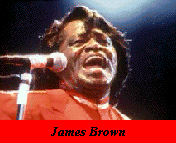
Motown and soul Music. In the 1960s the three most important styles of R&B were: (1) Chicago soul, influenced by gospel-music songs; (2) the Motown sound, which combined polished songwriting with a straightforward vocal delivery; and (3) southern soul, the most gospel-influenced style of R&B. Chicago soul was epitomized by the work of singer and songwriter Curtis Mayfield with the group the Impressions. Mayfield tended to write what he termed "songs of faith and inspiration," with compositions such as "People Get Ready" (1965), which featured several different lead singers trading vocal lines in call-and-response fashion. Other trademarks of Mayfield and the Chicago soul genre included the frequent use of falsetto (an artificially high voice), the writing of idiosyncratic parts for stringed instruments, the use of the vibraphone (a musical percussion instrument), and a song structure that incorporated short two- and four-bar interludes, often arranged for unique instrumental combinations such as vibes and guitar.In 1959 the Motown record company (see Motown Record Company, L.P.) was formed by Berry Gordy, Jr., in Detroit, Michigan. Gordy was so successful at developing a recognizable sound for Motown recordings that the company name quickly began to be applied as a designation for a genre of music. The most important Motown artists of the 1960s included singer Diana Ross with the female vocal group the Supremes, singer and songwriter Smokey Robinson with the male vocal group the Miracles, and the male vocal group the Temptations. The majority of Motown artists (exceptions including saxophonist Junior Walker and singers Marvin Gaye and Stevie Wonder) were vocal groups that updated the doo-wop style of the 1950s with a heavy, even beat. The productions were ornate, laden with strings and horns. Influenced by Tin Pan Alley, a popular style of American songwriting (see Popular Music: Early 20th Century), the compositions and arrangements were exceedingly well crafted. Motown represented the sound of American youth through most of the 1960s and, for an independent record company, achieved unprecedented success. Southern soul was originated by singer and songwriter James Brown and singer and pianist Ray Charles. On many of the earliest soul records, Charles would take a traditional religious song, such as "I Got Religion," and transform it into a secular paean to love ("I've Got A Woman," 1955). This style was fully realized on recordings issued by Memphis-based Stax Records and New York-based Atlantic Records in the mid- and late 1960s with vocal artists such as Aretha Franklin and Otis Redding. Beginning at the same time as Motown, Stax developed its own unique, identifiable sound around a studio band consisting of instrumental group Booker T. and the MG's, keyboardist Isaac Hayes, and the Mar-Key horn section (later the Memphis Horns). With star artists, such as Redding and soul duo Sam and Dave, producing a sparse, gospel-derived sound, Stax performers sold records to white audiences while generating substantial record sales among black audiences. By adding such refinements as string accompaniments, southern soul remained a significant presence in popular music throughout much of the 1970s, with such successful artists as the family vocal group the Staple Singers and Memphis-based singers Isaac Hayes and Al Green.
Funk and Disco. In
the late 1960s, at the height of soul music's popularity, significant
changes in cultural views began to be articulated by many black Americans.
Black militancy began to make its presence felt, accompanied by an
increased sense of African heritage. This cultural and social emphasis on
African identity was reflected in popular music. With the song "Cold
Sweat" (1967), James Brown signaled the birth of funk music. Funk
de-emphasized melody and harmony, bringing rhythm, the defining aspect of
African music, to the foreground. Funk recordings, like much indigenous
African music, often consisted of a complex groove in which every
instrument played a different rhythm, and all sounds fit together like a
jigsaw puzzle. Complete verses and choruses were often written without a
chord change. This style was adopted by a number of artists, perhaps most
significantly by soul group Sly and the Family Stone and vocalist George
Clinton with the groups Parliament and Funkadelic. These musicians
synthesized the funk style with elements from white rock music.
Dance music and Rap. In
the 1980s and 1990s disco gave way to a number of other genres. During
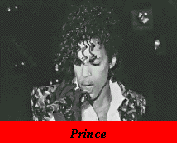
this period, superstars such as Prince, Michael Jackson, and Janet Jackson
worked within funk and other styles of dance music and produced songs by
borrowing from a number of styles. Michael Jackson, in particular, was
influenced by popular music from other ethnic regions, most notably
Central and South America (see Worldbeat). Although a number of hybrid
styles were created during this time, most popular R&B music remained
dance-oriented. Moreover, with the rise of music video in the early 1980s,
the dancing abilities of performers gained much greater significance.
R & B Current trends. By the mid-1990s, elements of rap-including sampling, scratching (a percussion technique that involves running a record needle manually across vinyl records), and declaimed vocals-had become part of what could perhaps best be described as dance-based, post-disco music. The vocal-group tradition of R&B continued, as did the prominence of solo vocal acts, such as singers Whitney Houston, Mariah Carey, and Luther Vandross.
R & B Sociological Significance. The
various styles of R&B have followed a cycle that originated in the
mid-19th century with music from minstrel shows. The general cycle starts
when black Americans develop a musical style that is an integral part of a
much larger black subculture, embracing language, fashion, demeanor, and
attitudes. From the outset of this development, a small number of white
Americans become interested in both the music and the subculture and
actively participate on the fringes of the nascent subculture. Eventually,
some of these white participants begin to make their own versions of the
music, some of which then gain widespread popularity among white youth.
The popularity of the music transfers part of the language, fashion, style
of dance, and attitude of the subculture into the mainstream of American
culture.
I am going to end here, I hope you did enjoy your visit and that you had the opportunity to find out some interesting things about our lovely music.
Best Regards to all of you,
Jimmi
|
Back to the first page
Have You Ever Seen The Rain "Midi"
|